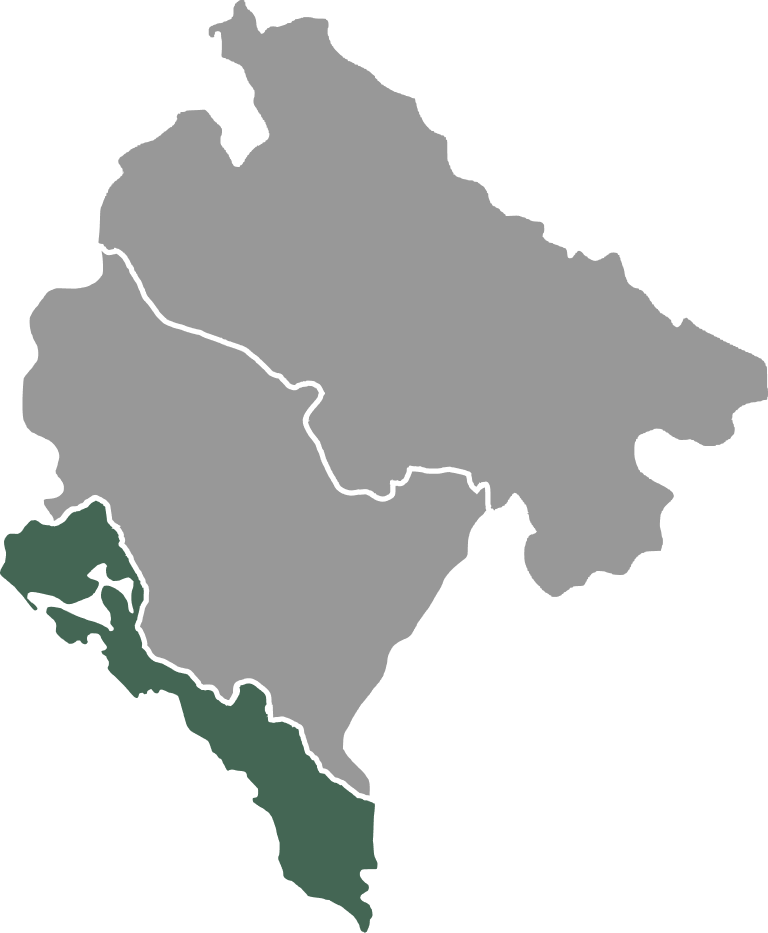
The southern region of Montenegro includes the coast from Ulcinj to Herceg Novi, together with the hinterland of Bar, Budva, Tivat, Kotor and Herceg Novi. Nearly a third of the country’s population lives here. This belt forms the most recognizable part of Montenegro, because here the Mediterranean climate, cultural layers shaped over millennia, and landscapes that change from kilometer to kilometer meet and intersect. The sun dominates most of the year, and the rhythm of life is intertwined with the sea.
The southern region is a blend of the scents of pine trees, salt, citrus fruits, ancient city walls and modern tourist facilities.
The Mediterranean character of the coast is shaped by steep mountain massifs that descend toward the sea. In the south lie the long sandy expanses of Ulcinj, where the landscape opens wide, flat and sunny. Moving north, the relief breaks into hills above Bar, peninsulas and elevations that surround Budva, before completely transforming in front of the Bay of Kotor.
Boka is a world of its own. The bay cuts deep into the land and creates remarkable landscapes. High mountains rise above the bay, while the shores curve into winding lines that hide villages, churches, old palaces and small harbors. Every segment of the coast has its own rhythm and its own beauty.
The southern region is the most culturally diverse part of the country. Ulcinj is recognized as the center of the Albanian community with a rich tradition and Mediterranean and oriental influences. Bar is a mixture of coastal, rural and modern urban culture. Budva is cosmopolitan and tourist oriented, filled with seasonal workers, visitors from all continents and a local population that has adapted to a modern rhythm.
Boka is a story of its own. Kotor, Tivat and Herceg Novi carry a Venetian, Austro Hungarian and Mediterranean imprint visible in architecture, language, customs and way of life. People in Boka are known for their connection to the sea, sailing, shipbuilding and the maritime tradition.
Montenegrins, Albanians, Serbs, Bosniaks and members of other peoples live in all these environments, while the large number of foreigners who move here further emphasizes the international character of the region.
Tourism is the main driver of the southern region, but not the only one.
Ulcinj lives from the summer season, olives, citrus fruits and fishing. Bar combines tourism, trade, transport and agriculture. The Port of Bar represents a strategic point for trade and logistics in the country.
Budva is the strongest tourist center with a developed hotel and hospitality business, luxury complexes and a large seasonal influx of guests. Boka leads in nautical tourism. Porto Montenegro in Tivat, Luštica Bay and Portonovi are international premium projects that have completely changed the standard of tourism in the region.
Kotor remains a blend of historical and cultural heritage with modern hospitality, while Herceg Novi possibly has the strongest tradition of health tourism, festivals and creative arts. Together, all these municipalities form the country’s most developed economic region. The Old Town of Kotor and the Bay of Kotor are on the UNESCO World Heritage list.
The southern region has a well distributed network of schools and kindergartens, while higher levels of education are most often continued in Podgorica or Nikšić. Budva and Bar have general high schools and vocational secondary schools.
Kotor hosts the Faculty of Maritime Studies and the Faculty of Tourism and Hotel Management, both part of the University of Montenegro, educating generations of seafarers and logistics experts. Herceg Novi has a rich tradition of fine arts education, music schools and cultural workshops. In Ulcinj, schooling takes place both in Albanian and in Montenegrin.
The coast is filled with cultural events throughout the year. Herceg Novi is known for the Mimosa Festival, film festivals and music events. Kotor is known for KotorArt, the Boka Night celebration and winter carnivals. Budva lives most intensely in summer with the Grad Teatar festival, carnivals, concerts and rich tourist entertainment.
Bar organizes the Bar Chronicle festival, cultural evenings, olive growing celebrations and international artistic programs. Ulcinj nurtures multicultural festivals and traditional ceremonies in the Old Town.
The entire region is a combination of modern music festivals, traditional customs, artistic colonies and local celebrations.
The northern part of the coast offers the landscapes of the Bay of Kotor, considered one of the most beautiful sea bays in the world. This area includes Perast, the islands of Our Lady of the Rocks and Saint George, fortresses, palaces and hidden beaches.
Tivat has large parks and a bay suitable for calm swimming. Herceg Novi abounds with rich Mediterranean vegetation and parks.
The central part of the coast, from Budva to Petrovac, is known for exceptionally beautiful beaches, lush pine forests and seaside promenades. Mogren, Jaz, Slovenska Beach, Bečići, Drobni Pijesak, Sveti Stefan and Buljarica are only part of the natural beauty of this segment.
In the far south are completely different landscapes. Velika Plaža in Ulcinj, Ada Bojana with river branches and winds ideal for water sports, Lake Šas, Valdanos with its olive groves and coves that still preserve untouched nature.
In the immediate vicinity of the southern region are also the national parks Skadar Lake and Lovćen, which further enrich the tourist offer with natural landscapes, excursion areas and cultural historical sites.
The southern region is well connected by highways and international routes. Tivat Airport serves the coast throughout the year. The Port of Bar is the largest seaport in the country and the main maritime gateway of Montenegro. It is connected by railway with Podgorica and Belgrade.
Bus connections are frequent and well organized, and coastal roads offer picturesque panoramas, although during the season they can be congested due to the large number of tourists.
The Kamenari Lepetane ferry line is also a critical point within Boka and connects Herceg Novi with Tivat. For a complete picture of connectivity, the airport in Podgorica should also be mentioned, which is a key entry point for tourists heading toward Bar and Ulcinj.
The coast is filled with sports opportunities. Nautical sports in Boka, diving near Budva and Bar, kitesurfing on Ada Bojana, trekking and climbing in the hills above the coast, cycling, swimming marathons and numerous sports tournaments make the southern region ideal for an active holiday.
The sailing tradition is also strong, as well as water polo, especially in Boka.
The southern region is the most valuable area in Montenegro when it comes to investment. Tourism revenues grow year after year, and the interest of foreign investors does not decline.
Budva is the strongest hotspot of residential construction and luxury projects. Bar has a huge advantage due to the port, the main highway and proximity to large markets. Ulcinj is the most promising area for future development due to vast land capacity and lower prices compared to the rest of the coast.
Kotor, Tivat and Herceg Novi attract the wealthiest clientele and have the highest real estate prices thanks to premium marinas, historic centers and breathtaking natural landscapes.
The southern region is the engine of Montenegro’s tourism capital and the area of the most stable growth in property value.
The southern region combines three completely different experiences in a small space: the endless sandy shores of Ulcinj, the lively Budva Riviera and the magical calm of the Bay of Kotor. It is a place where history intertwines with modern luxury, where olives are thousands of years old, where the sea has different shades along every stretch of coast and where the rhythm of life changes from settlement to settlement.
Life in the south is connected with the sea and the sun. People live more slowly compared to the central region, but the seasonal rhythm brings an impulse during summer when the towns fill with tourists, events and energy.
Winters are mild, summers warm, nature diverse and the sea always present. Everyone can find their own rhythm: the calm of Ulcinj, the dynamism of Budva, the elegance of Tivat, the authenticity of Bar, the historic charm of Kotor or the relaxed atmosphere of Herceg Novi.
View listings in Seaside